The Complete Guide to Africa’s Most Elusive Big Cat
Few wildlife encounters rival the moment a leopard materialises from the tall grass of the Maasai Mara — rosette coat glowing gold in the afternoon light, unhurried, sovereign. Panthera pardus is the most adaptable of Africa’s big cats, yet paradoxically the hardest to find. Understanding how leopards live is the first step to experiencing them in the wild.
Physical Characteristics
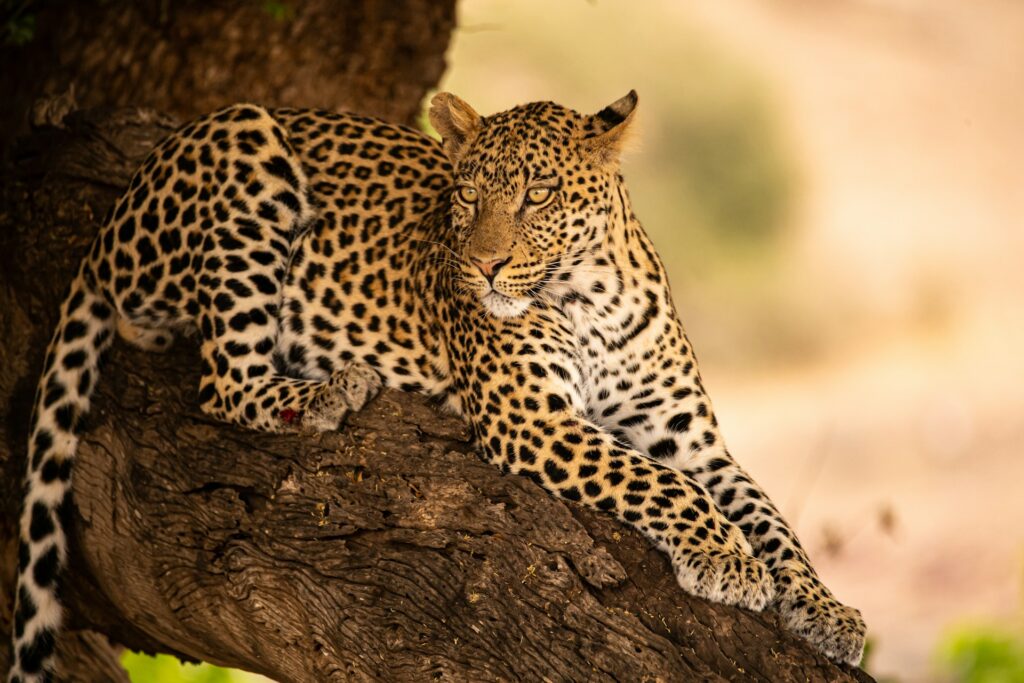
Leopards are medium-sized big cats — larger than cheetahs, more compact than lions — with males weighing 50–90 kg and females 30–60 kg. Their defining feature is the rosette coat: circular markings forming rings around lighter centres, distinct from the cheetah’s simple solid spots. This pattern fractures the leopard’s outline in dappled vegetation, making a 70 kg predator effectively invisible at 10 metres.
Black leopards (“black panthers”) carry a recessive melanistic gene that floods their coat with dark pigment. In direct sunlight, rosettes remain faintly visible beneath the black. Melanism is more common in dense forests where the camouflage advantage is greatest.
Pound-for-pound, leopards may be the strongest of the big cats. They routinely hoist kills weighing 50–70 kg — sometimes exceeding their own body weight — straight up a tree trunk, a feat requiring extraordinary power in the legs, shoulders, and jaws. Their climbing ability, flexible spine, and semi-retractable claws also make them the most accomplished arborists of Africa’s predators.
Hunting Behaviour
Leopards are ambush hunters. They stalk prey using cover, moving only when their quarry is distracted, closing silently to within 5–10 metres before launching an explosive charge. The kill comes via a suffocating bite to the throat or nape, held for up to 25 minutes.
Their success rate is remarkable: roughly 38% of hunts succeed, compared to lions’ 25–30%. This efficiency reflects both the quality of their stalking and the advantage of hunting alone rather than coordinating in groups.
Once a kill is made, leopards cache carcasses in trees to protect them from lions, hyenas, and wild dogs that would steal ground-level food. A single impala can sustain a leopard for several days, with the cat returning to feed at intervals.
Dietary range is impressive — impala, bushbuck, warthog, baboon, hares, reptiles, and birds all feature on the menu. This dietary flexibility is a core reason leopards thrive where other predators cannot.
Behaviour and Social Structure
Leopards are strictly solitary outside of mating. Male territories (20–60 km²) overlap several female home ranges (10–40 km²) and are defended through scent marking, sawing vocalisations audible up to 2 km away, and — when necessary — violent confrontation.
They are predominantly nocturnal, most active in the cooler evening and pre-dawn hours, which reduces competition with lions and cheetahs. In areas like the Maasai Mara where lion pressure is high, this nocturnal shift is especially pronounced. However, leopards are flexible: on overcast days or in areas of low predator competition, daytime sightings are entirely possible.
Females raise cubs alone, typically 2–3 per litter. Cubs are hidden for the first 6–8 weeks and begin following their mother at around three months. They remain dependent for 12–18 months, learning hunting techniques through observation and play. Cub mortality runs high — 40–50% — with lions, hyenas, and infanticide from rival males accounting for most losses.
Leopards of the Maasai Mara
The Maasai Mara ecosystem supports one of Africa’s most robust leopard populations. The landscape — riverine forest corridors threading through open savanna — suits leopards perfectly. Fig trees and acacia woodland along the Mara, Talek, and Sand rivers provide both hunting cover and caching sites. The high density of impala, the leopard’s preferred prey in this ecosystem, keeps territories well-provisioned year-round.
What makes the Mara particularly special for leopard viewing is habituation. Leopards that grow up around responsible safari vehicles lose their instinct to flee, allowing extended, close-range observations that are impossible in areas with less consistent wildlife tourism. This means watching a leopard feed, groom, or descend from a fig tree — not merely glimpsing a tail disappearing into a thicket.
Leopard sightings in the Mara peak during the dry seasons (July–October and January–February), when reduced vegetation cover makes these secretive cats easier to spot and prey concentrations attract them to predictable corridors.
Where to See Leopards: The Mara Advantage
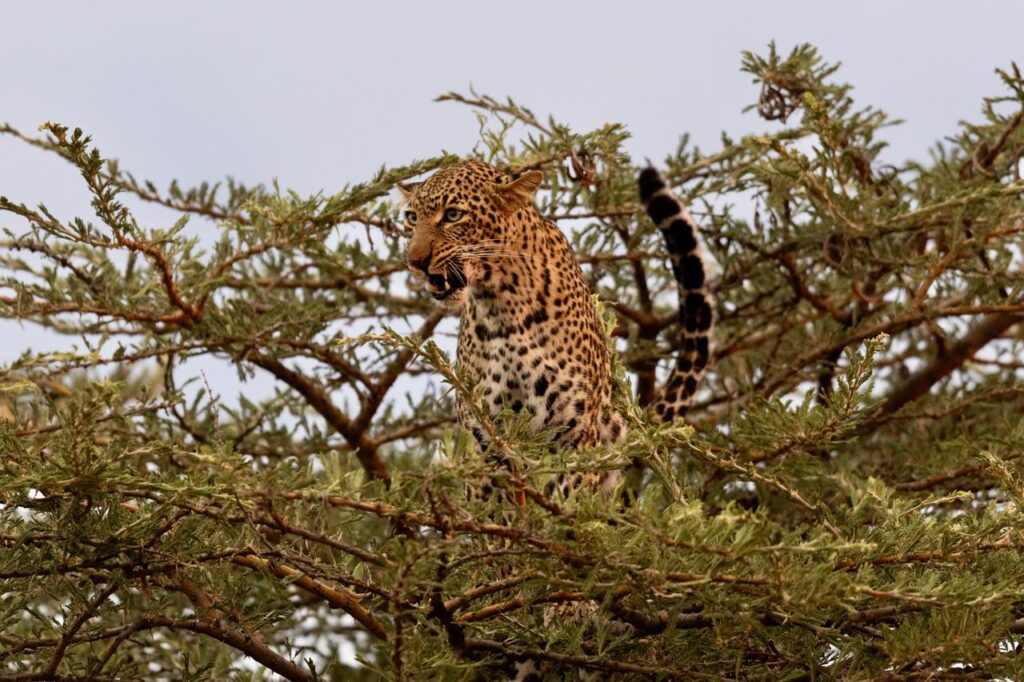
Leopards rank as the most challenging of the Big Five to see on safari. Their nocturnal habits, solitary nature, perfect camouflage, and avoidance of open ground all conspire against easy sightings. Guests at busy lodges covering vast circuits rarely linger long enough for the quality of encounter that makes a leopard sighting truly memorable.
Enkakenya Mara Camp is positioned in the heart of leopard country within the greater Mara ecosystem. Small camp size means fewer vehicles at a sighting, more time spent with the animal, and game drives tailored to wherever leopard activity has been tracked — rather than a fixed route. Experienced Maasai guides who know individual leopards by territory and behaviour make an enormous difference, turning a potential fleeting glimpse into an intimate, unhurried encounter.
The Mara’s leopards are most reliably found along riverine forest edges at dawn and dusk — exactly the windows Enkakenya’s game drives are structured around.
Conservation Status
Leopards are classified as Vulnerable on the IUCN Red List globally, though status varies sharply by subspecies. The Amur leopard (Russian Far East) numbers fewer than 100 individuals; the Arabian and Javan leopards are both Critically Endangered. African leopards represent the healthiest populations, yet declines of 30% over three generations have been recorded across parts of their range.
Primary threats include habitat fragmentation, retaliatory killing following livestock predation, poaching for the illegal parts trade, and depletion of prey through bushmeat hunting.
The Maasai Mara’s leopards benefit from one of Africa’s most established protected ecosystems — and from community conservancies surrounding the reserve, which extend wildlife habitat and reduce human-wildlife conflict. Choosing community-anchored camps like Enkakenya directly supports the conservation model that keeps these populations stable.
Frequently Asked Questions
Are leopards dangerous to humans? Generally not. Leopards actively avoid people. Attacks are rare and almost always involve cornered, injured, or provoked individuals. Safari viewing with experienced guides is very safe.
Can leopards swim? Yes. Leopards are capable swimmers and will cross rivers when necessary, though they don’t seek water the way tigers or jaguars do.
Do leopards roar? Not with the sustained power of a lion. Their vocalisations include rasping coughs, growls, and a distinctive sawing call — a series of rough rasps described as the sound of wood being cut — audible up to 2 km away.
How long do cubs stay with their mothers? 12–18 months. By dispersal, most cubs can hunt independently. Daughters often establish territories near or overlapping their mother’s range; sons disperse further.
What’s the best time to see leopards in the Maasai Mara? Year-round sightings are possible, but July–October and January–February offer the best conditions — dry vegetation, concentrated prey, and leopards more active in daylight hours.
Experience the Mara’s Leopards at Enkakenya
A leopard sighting is never guaranteed — that uncertainty is part of what makes it extraordinary. What can be arranged is the best possible chance: the right location, the right guides, and the unhurried rhythm of a small camp that lets you stay with an animal for as long as the moment lasts.
Enkakenya Mara Camp — where the Mara’s leopards are more than a photograph. They are an encounter you carry home.